Blog

  • The Nomadic Geologist: Chalk, Chicken & Contamination in Essex

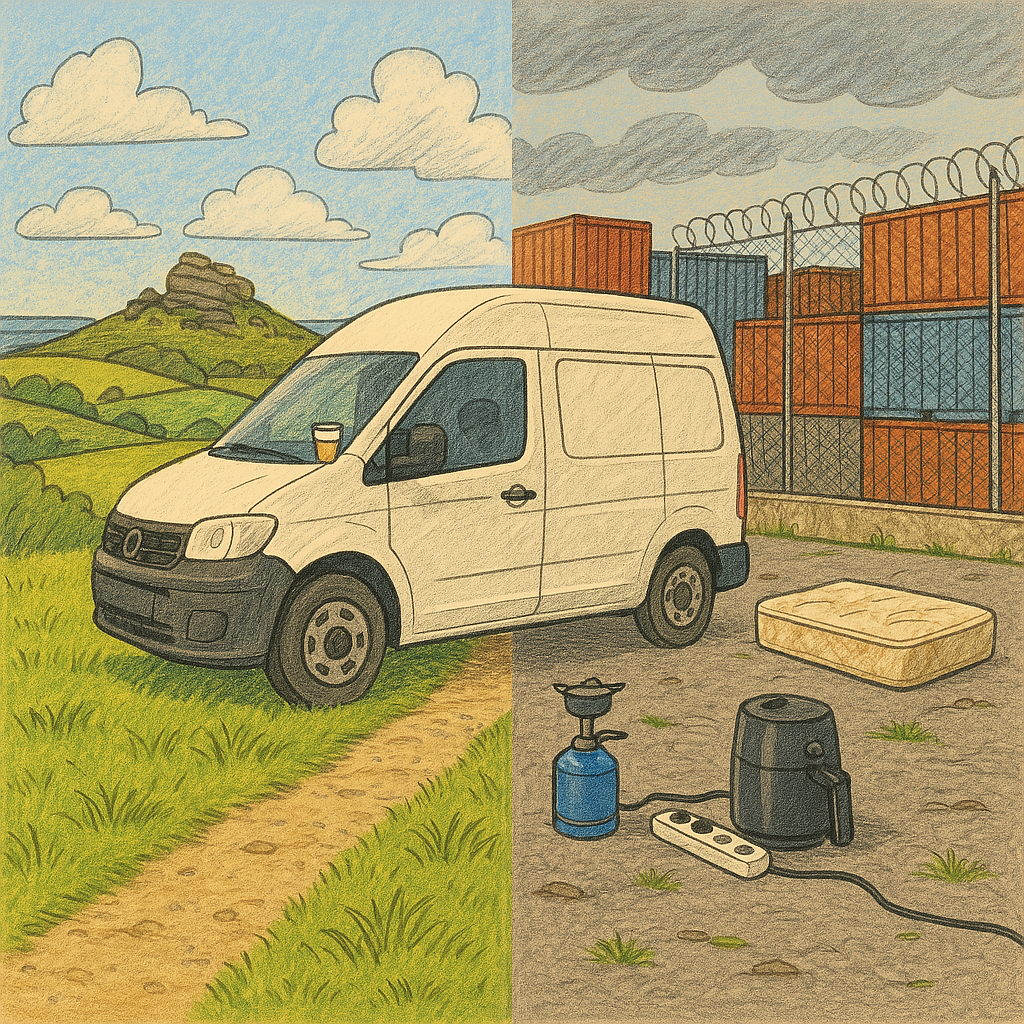
    When you grow up among the rolling hills and weathered tors of the South West, landing a contract in Essex feels like you’ve been transported to a parallel geological dimension—one paved in concrete, dotted with shipping containers, and alarmingly rich in abandoned mattresses.

    Yes, I’ve crossed county lines and now find myself deep in the industrial arteries of Essex. The campervan is my trusty base of operations, and I alternate between the relative luxury of campsites (with their glorious electric hook-ups) and the shadowy realm of stealth camping. There’s a certain thrill to whipping up dinner on a gas stove in a B&Q car park, with my air fryer buzzing quietly as it works its magic on some slightly questionable breaded chicken.

    The geology here is not what I’m used to. Gone are the familiar sandstones and slates of the Westcountry. Instead, I’ve stepped into the world of contaminated land. My site is a strange patchwork of made ground, classed as BDA red—basically a polite way of saying “mystery fill, but definitely hazardous.” Beneath that, we’ve got some Alluvium, River Terrace Deposits, and the ever-reliable Lewes Nodular Chalk. There’s a decent bit of stratigraphy here… if you can get past the fridge dumped in the hedgerow.

    The work is fascinating, and definitely outside my usual wheelhouse. I’ve been thrown into a technical speciality I’m not quite qualified for, so naturally, I’m spending evenings frantically Googling terminology and pretending I’ve known it all along. “Oh yes, definitely VOCs showing up in that groundwater plume… just as I suspected.” This might become a recurring theme—“Fake it ’til you make it: The Contaminated Chronicles.”

    Despite the unusual setting, the team is brilliant—friendly, helpful, and good-humoured. They’ve made the adjustment smoother, and it’s been nice to be challenged in new ways. The weather’s been weirdly great too, which has made campervan life far more bearable. Long may it last.

    When I’m not sleuthing for hydrocarbons or cooking off the tailgate, I’ve been seeking out local distractions. The cinema has become a regular haunt—even if the listings are somewhat tragic. I’ve now seen ‘A Complete Unknown’ four times. At this point, I’m not even sure if I like it or if it’s just become part of my Essex routine. Luckily, they did a rerun of The Big Lebowski the other week—a beacon of joy and chaos in a land of retail parks and skip fires. I’ll never tire of watching The Dude abide.

    So here I am, the Nomadic Geologist, knee-deep in made ground and makeshift meals, forging a strange new rhythm in Essex. It’s not what I’m used to—but then again, that’s the point.

    Until next time—stay curious, stay mobile, and always check for asbestos.

    – The Nomadic Geologist
  • Back in the Office – Counting mugs and meetings 

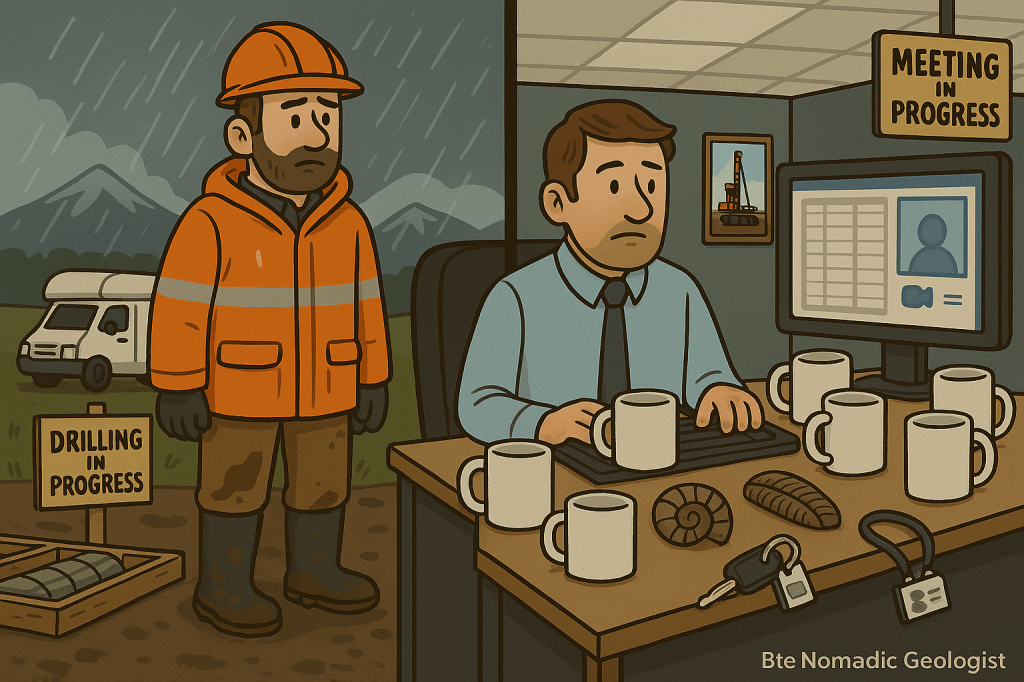
    Well, it’s happened. I’ve swapped my steel-toes for office-friendly shoes, the campervan for a company car park (with very clear “no overnight parking” signs), and my daily dose of fresh air for a steady stream of recycled office oxygen. I’m back in the office.

    It’s familiar turf — I spent the middle chunk of my career in this setting, managing projects from behind a desk. But for the past several years, I’ve been out there, boots on the ground, living the field life from my trusty campervan.

    Now don’t get me wrong — there’s something oddly comforting about walking into a building that doesn’t sway in the wind, with heating that doesn’t rely on whether the van battery made it through the night. There’s tea on tap, a toilet that flushes (a luxury we field folk don’t talk about enough), and people wandering about in clean clothes, talking about things like “strategy” and “delivery milestones.” And not a whiff of diesel in the air.

    But after a few days of nodding thoughtfully in meetings, pretending to understand the latest version of the project Gantt chart, I’m starting to remember why I left this life behind.

    Sure, I get to look important when I say things like “let’s circle back” and “we need to work collaboratively on this,” but I’d trade all of it for a half-decent drill crew and the sound of core trays clattering in the wind. And don’t get me started on Teams Meetings. If ever there was a scourge on the working world… video meeting after video meeting, calendar blocks overlapping like tectonic plates. Most could’ve been an email. Or, even better, nothing at all.

    And while the endless tea supply is great in theory, I think I’ve now consumed enough tannins to preserve myself well into the next epoch. At least on site, it’s one strong brew in the morning and then back to rocks and reality. Out here, I’m just counting mugs and meetings.

    Then there’s the commute — the same place, every day. It’s a strange form of time travel, watching the same hedgerows blur past, the same pothole dodged, the same car park, the same everything. Out in the field, every drive is new. Every day brings a different horizon, a different weather system trying to kill you (or at least trying to delay the drilling program). It’s oddly invigorating.

    And yes, fieldwork comes with its own, let’s say, quirks — like brushing your teeth in a gale or discovering your PPE is definitely not fully waterproof. But what it lacks in creature comforts, it makes up for in adventure. Real adventure. The kind where you’re digging through glacial till with frozen fingers and still thinking, “I wouldn’t trade this for all the tea in the office.”

    Well. Almost all the tea.

    The only real downside to field life? Being away from my family. That bit never gets easier, and I’d be lying if I said it didn’t weigh heavy some days. But that absence also makes the return sweeter — swapping stories, muddy boots at the door, and maybe even a proper loo break.

    For now, I’ll ride out this stint in the warm, well-lit world of offices. I’ll tick the boxes, write the risk assessments, and nod sagely in meetings. But soon enough, I’ll be back where I belong — chasing rocks, dodging rainstorms, and living life one van park-up at a time.

    Until then — keep it muddy.

    The Nomadic Geologist

  • The Nomadic Geologist…. goes fishing in Shropshire (for Steel)

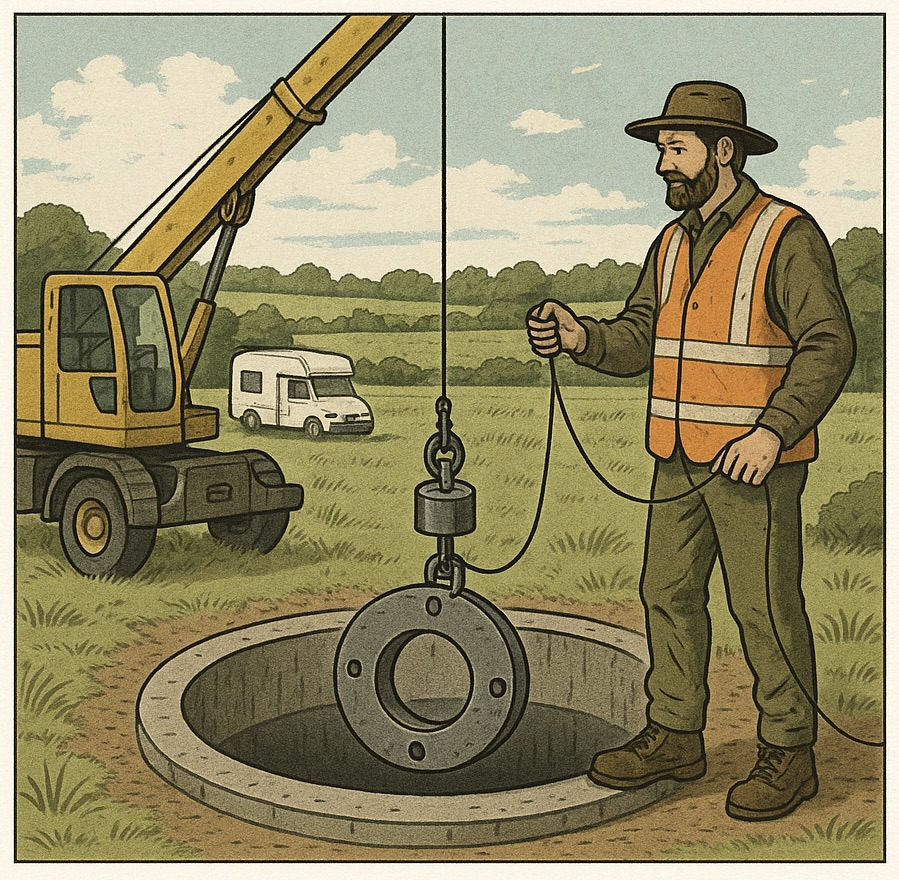
    This project has been one of the more bizarre assignments in my nomadic geological journey—part hydrogeology, part engineering, and part good old-fashioned fishing. I found myself deep in the rural heart of Shropshire, parked up in my campervan just two fields from the site. It was one of those rare setups where I could stroll to work, boots still damp with morning dew, through hedgerows humming with birdsong. Pure countryside bliss—if you ignore the 100-metre death hole.

    Let me explain.

    I was contracted to assist in the cleaning of an existing groundwater extraction borehole. But here’s the twist—there was no drill rig, no rock dust, no core samples. Just a crane, some burly drillers from up north, and a 10-ton, 6-metre-long, 24-inch-wide cylindrical brush that looked more like a medieval siege weapon than a piece of hydrological equipment. This thing had been custom-built for the job, because the borehole was massive—so wide a person could easily fall in and keep falling for a full 100 metres. And standing on the edge, even in a harness, gave me that primal feeling you get at the edge of a sea cliff: a weird internal lurch that says, Don’t jump, don’t jump, even though you’d never dream of it.

    The borehole itself serves a strange purpose. Groundwater is pumped from this point to feed back into the nearby river—an artificial recharging effort to maintain river levels at the spot where water is abstracted for human use. So, in essence, water is being removed from the ground only to be put back into the system from another angle. Necessary, apparently!

    Then came the fishing mission.

    Some rogue steel had been dropped down the borehole years ago. A job for some high-tech equipment, right? Wrong. This was no fancy operation. It was just us and a magnet on the end of a long piece of string, bobbing it up and down like kids hoping for a tin can at the bottom of a well. Two full days of this low-tech wizardry, and finally—clunk. We pulled it out like victorious anglers, cheered on by tea in steel mugs and sarcastic commentary from the lads.

    Now, the drillers—let’s just say they were proper northern blokes. Salt of the earth, heavy on the banter, and not always tuned in to the delicate sensibilities of a soft-spoken southern geologist like myself. Conversations were… navigated. Sometimes avoided altogether. But their work ethic? Impeccable.

    After the cleaning, we ran a downhole survey, gave the pumps a good test run, and called it a job well done. The borehole sparkled like a freshly brushed chimney—if chimneys ran a hundred metres straight into the ground.

    Not a single rock sample, not a sliver of core, no fossils or faults. Just steel, water, and a magnet on a string.

    Sometimes geology isn’t about the rocks you see. Sometimes, it’s about the ones you don’t. And sometimes, it’s just about not falling in the bloody hole.

    Until next time,

    The Nomadic Geologist

  • The Nomadic Geologist: Top Secret Geology

    Every now and then, I take a job that I can’t talk about. This is one of those times. For this contract, I signed more NDAs than there are fossiliferous layers in a carbonate platform. I can’t tell you where I am. I can’t tell you what I’m doing. And I definitely can’t tell you who I’m doing it for. But what I can share is the strange, cloistered life of a geologist working behind the veil.

    The project began in the way these things often do: you’re hired for your experience, reputation, and a solid CV, and then, on day one, you’re forced to explain your worth to the client’s client who couldn’t tell the difference between a weathered fault plane and a smear of bentonite drilling mud. My particular inquisitor put me through what felt like a geological version of the Spanish Inquisition. I kept the passive aggression to a professional minimum. Barely.

    Once inside the perimeter fence, life got… simple. For a couple of months, I was effectively a prisoner (albeit a paid one) inside a converted shipping container with one other geologist. Our lab-slash-office cabin measured about 2 by 6 meters—barely enough room for our core trays, let alone our egos. We were visited only by security guards doing their rounds, checking our IDs as if we’d somehow managed to swap identities in the ten minutes since their last visit.

    The purpose of the project? Let’s say I wasn’t entirely comfortable with its end goal. Sometimes I felt like one of those nameless scientists in a Bond villain’s lair—tinkering with something that might change the world, but not necessarily for the better. But the rocks didn’t care, and neither did the data.

    We were studying a fascinating carbonate sequence—beautifully preserved, with well-defined marker beds, interrupted by fault zones that posed some rather specific geohazards. Mapping those faults was like playing geological detective: unpicking past tectonic tantrums to predict future headaches for whoever ends up breaking ground here.

    I hadn’t met my fellow geologist before this project. At first, it was like two tectonic plates grinding past each other, all tension and potential for a full-blown subduction zone. But, slowly, a kind of professional plate boundary formed—transform, maybe—with friction giving way to flow. Our backgrounds were different: they approached the rocks with an academic’s curiosity, I with a practical, boots-on-the-ground mentality. It could have clashed. Instead, it harmonised.

    We spent hours in nerdy debates: facies interpretations, fossil assemblages, sequence boundaries, even best methods for sample preservation. We disagreed often, but those disagreements sharpened our analysis. It was proper scientific collaboration—the kind that brings out the best in you and reminds you why you started doing this work in the first place.

    In the end, we built something better than just a stratigraphic model. We built trust from the client, a highly tuned geological data set, and a solid professional friendship. Not bad for two people locked in a steel box in the middle of nowhere.

    Top Secret? Sure. But the geology was real, the challenges were rewarding, and the connection I made with a fellow geologist might just be the best-kept secret of all.

    Until next time

    – The Nomadic Geologist

  • The Nomadic Geologist: Core Logging and Co-Op Meal Deals in North Wales

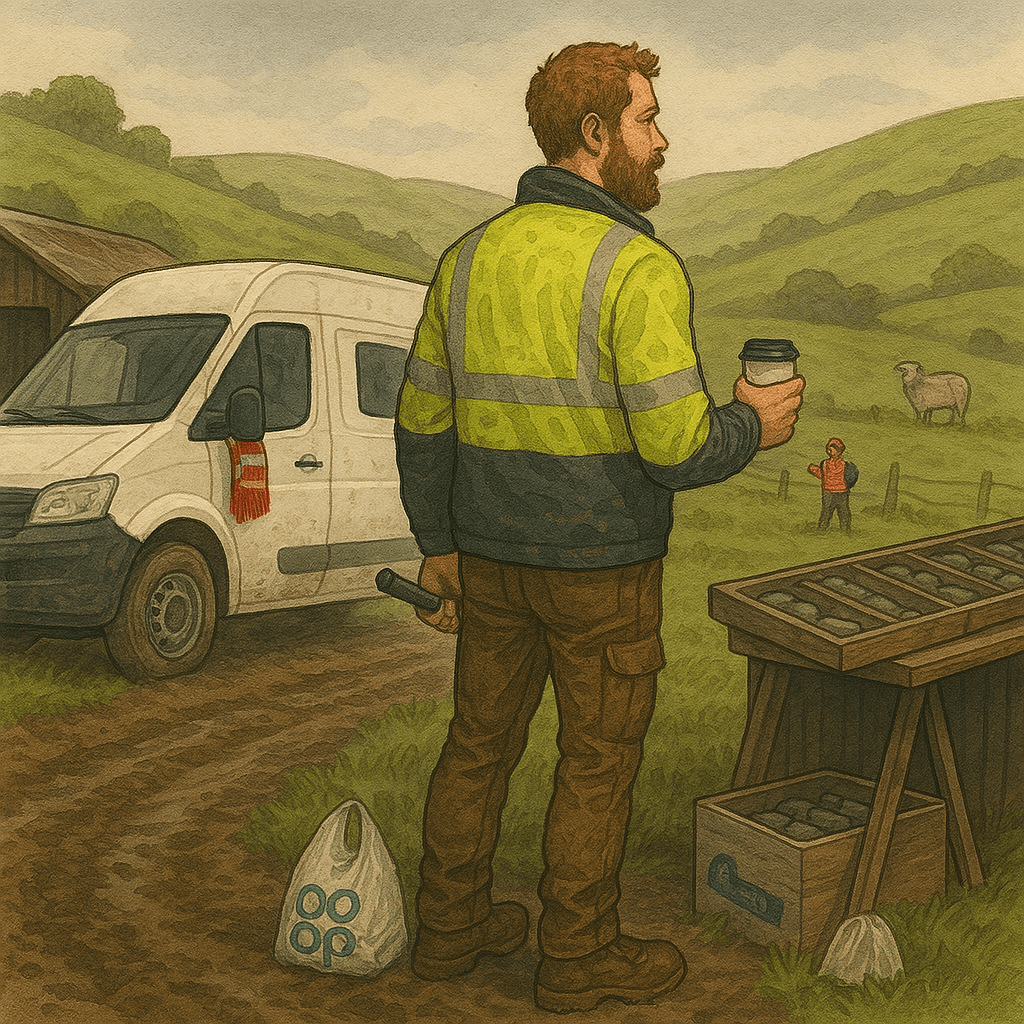
    There’s a certain rhythm to returning to something you haven’t done in a while – a blend of nerves and muscle memory. For this project I found myself in North Wales, undertaking a task I’ve done many times before: core logging. For the first time in a while though, it’s my full-time focus for the contract. Solely logging core. No Teams meetings, no spreadsheets pretending to be science—just cold, hard rock and questionable instant coffee.

    I showed up on day one with the usual mix of confidence and quiet anxiety. But I put on my best “I’m definitely qualified” face and dove in. Turns out, I still know what I’m doing. In fact, I’m annoyingly efficient…if perhaps overly confident. Before long I’d remembered that I actually enjoy this.

    The drilling pace, meanwhile, was… relaxed. Let’s call it “serene.” Which meant a lot of time hanging about, waiting for fresh core. I filled the gaps with conversation—mostly with a group of young, wide-eyed engineers who still have hope in their eyes—and the drillers, who are basically geological pirates: rough, loud, slightly inappropriate, but strangely endearing. Within days, we’d bonded over mud, sarcasm, and an unspoken agreement that no one would agree they were actually having an enjoyable time at work.

    Home for the project was, as always, my trusty campervan. I’d parked up at a farm campsite that was… let’s say, unique. Quiet and scenic, which I liked. The owners? A bit rough around the edges, but kind-hearted. The kind of place where you’re not quite sure if the shower’s going to work, but they’ll offer you a cup of tea while you wait for the plumber. It’s all part of the charm.

    Daily cuisine was dominated by the local Co-op, where I discovered a meal deal masterpiece: Costa coffee and four eggs (two in a tub and two in a sandwich). It’s the little wins that carry you through the day.

    Once a week, I’d treat myself to civilisation by driving into Wrexham. A Nando’s and the cinema became my little ritual. It was during one of these evenings that I made a horrifying discovery—I’ve become emotionally invested in Wrexham FC. I don’t like watching football. I wasn’t a Ryan Reynolds fan. And yet, here I am, binging a Netflix docuseries, checking Wrexham scores, and reconsidering Green Lantern.

    Navigating Wales’ new 20mph speed limit, meanwhile, has been character-building. Nothing says “rural road rage” like crawling behind a tractor that’s technically breaking the law. By going 21.

    Geologically, the site’s been a treat—mostly limestone, with the occasional mudstone cameo and a crust of stubborn boulder clay. Every now and then, I’d spot some lead mineralisation that made me do a little geologist happy dance (internally, of course—I’m still professional). The scenery here is magnificent in that uniquely Welsh way: staggeringly beautiful but also mildly threatening, like it might rain a sheep on you at any moment.

    The client’s been brilliant—chill, smart, and refreshingly free of jargon. The only real drama came, predictably, from land access. But in a twist no one saw coming, it wasn’t the landowners causing trouble—it was the land agents, who seem to have mistaken “facilitate access” for “cause chaos and send long passive-aggressive emails.”

    Still, we made it to the end. Just as the project fatigue was beginning to dull the sparkle in everyone’s eyes, we wrapped up. The finish was marked with enough handshakes, back-patting, and exaggerated declarations of teamwork to make a Hollywood sports movie blush. All well deserved, I’m sure.

    This job reminded me exactly why I chose this path—being a Nomadic Geologist. The people. The unpredictable beauty of rural Britain. The unexpected fondness for egg sandwiches and obscure football clubs. The quiet joy of falling asleep in a van parked in the middle of nowhere, knowing that tomorrow you’ll wake up and do it all again.

    Until the next rock face.

    The Nomadic Geologist